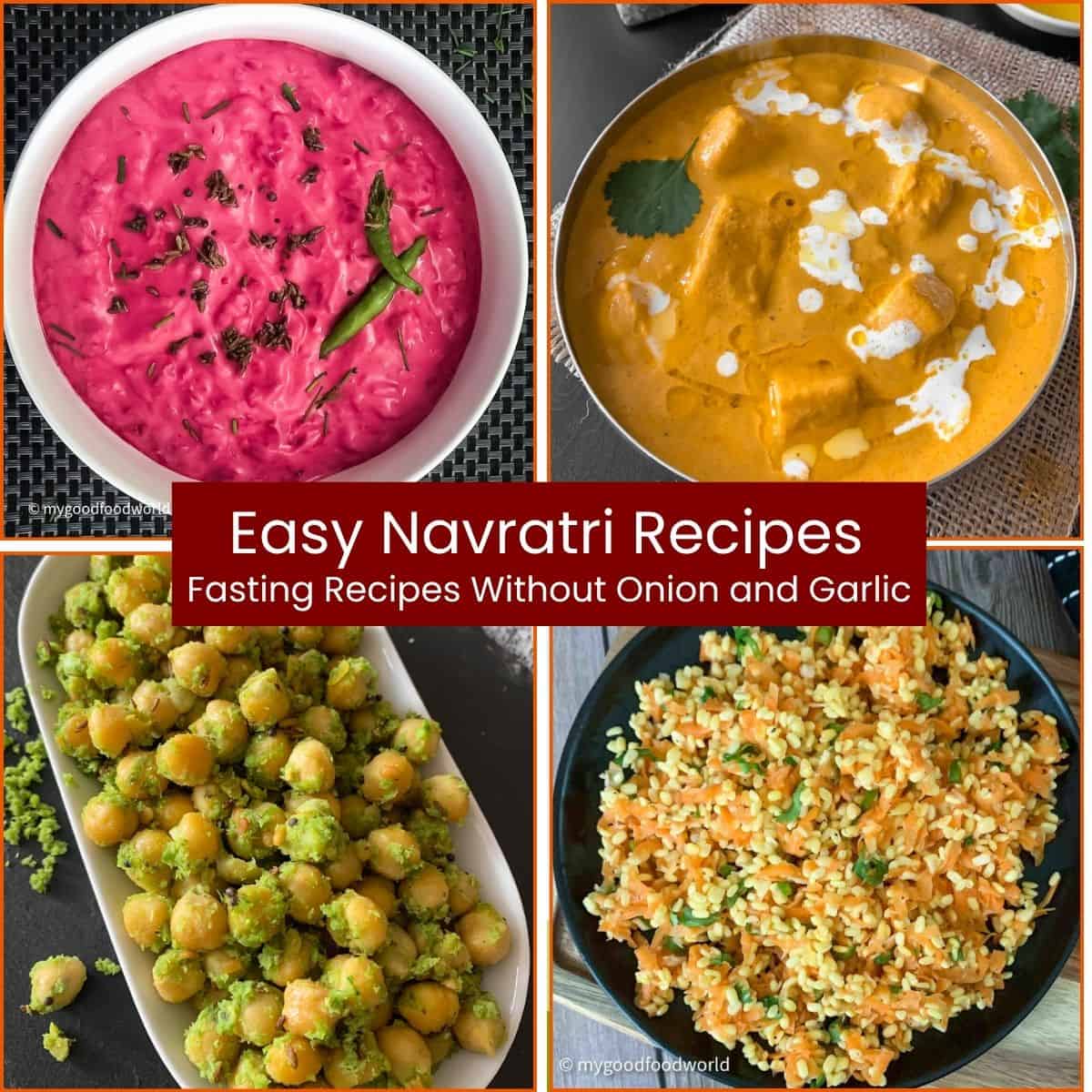
Navratri begins on October 11 this year, and if you're looking for fasting Navratri recipes that are actually satisfying, you're in the right place.
Save This Recipe
Enter your email & I'll send it to your inbox.
By submitting this form, you consent to receive emails from MyGoodFoodWorld
When you think about it, nine days without onion and garlic sounds like a lot. I used to feel the same way.
But once you start cooking with whole spices, fresh ginger, and the natural sweetness of legumes and vegetables, you realize that alliums were never really the hero of the dish. They were just the starting point.
One quick note before you dive in: most of these recipes call for regular salt. If you observe the Navratri tradition of using only sendha namak (rock salt), swap it in wherever the recipe calls for salt. The quantity stays the same.
This collection of Navratri recipes without onion garlic includes several from the South Indian Navratri tradition.
In South India, Navratri is celebrated as Kolu or Golu, where dolls and figurines are arranged for nine days as an offering to the goddess.
Sundal is the signature food of South Indian Navratri. It is made with a different legume each day and served as prasadam (an offering to the divine). Throughout this collection, you'll find sundal, kosambari, cabbage poriyal, and a few other South Indian recipes.
If you want to explore more allium-free cooking beyond Navratri, my no-onion, no-garlic recipe collection is a great place to start.
Jump to:
A note about Navratri fasting
Navratri fasting (upvas) rules vary by region and family tradition, so think of this as a general guide rather than a strict rulebook.
Most people observing Navratri avoid onion, garlic, non-vegetarian food, and regular table salt (substituted with sendha namak).
In some regions, Navratri fasting recipes also do not include regular grains like wheat and rice and instead use buckwheat (kuttu), water chestnut flour (singhara), sago (sabudana), and amaranth (rajgira). Others include rice in their fasting. Dairy, fruits, nuts, and most vegetables are generally permitted.
All of these Navratri fasting recipes are made without onion and garlic. Where a recipe includes rice, I've noted it so you can decide as per your fasting rules.
Mains and Curries



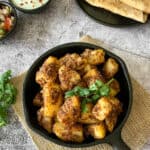

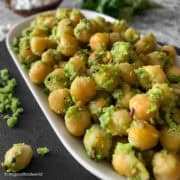
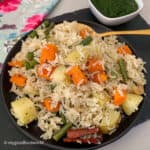
Rice and Grains
These recipes include rice, so they're best suited for days when you include rice in your fasting. If you avoid grains entirely, pair the curries above with the buckwheat roti in the next section instead.
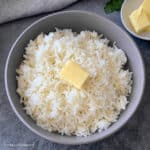


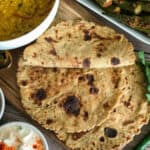
Rotis and Dosas


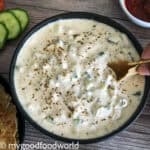
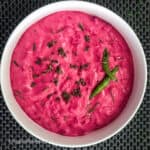
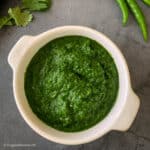
Salads and Sides



Sweets
Finish your meal with a delicious bowl of kheer, one of the most beloved festive sweets.
My Instant Pot rice pudding is made with just three ingredients. It's creamy and fragrant, and making it in the Instant Pot means your hands are free to attend to other things while it cooks. It's ready in a fraction of the time the stovetop version takes.
Make a big batch because it disappears fast!
FAQs
During Navratri, most people eat foods without onion, garlic, and regular table salt. Common choices include fresh fruits, dairy products like yogurt and paneer, root vegetables like potatoes and sweet potatoes, and grain-free flours like buckwheat and water chestnut. Many people also eat rice on days when grains are permitted. The exact rules vary by region and family tradition.
Popular Navratri fasting recipes include paneer dishes like shahi paneer and paneer bhurji without onion or garlic, lentil dishes like moong dal and mung bean soup, and vegetable dishes like aloo matar, aloo jeera, and bottle gourd sabzi.
I also make jeera rice, buttered rice, and kitchari.
Buckwheat roti is the most traditional fasting bread, and chickpea sundal is a classic South Indian Navratri prasadam. All are made without onion, garlic, or regular salt.
Most Navratri fasting diets allow fresh fruits, dairy products including milk, yogurt, paneer, and ghee, and most vegetables including potatoes, sweet potatoes, pumpkin, and bottle gourd. Nuts and peanuts, and grain-free flours like buckwheat, water chestnut, amaranth, and sago are also allowed. Sendha namak (rock salt) is used in place of regular table salt. Onion, garlic, meat, and regular grains like wheat and rice are typically avoided, though some people include rice in their fasting.
In South India, Navratri is celebrated as Kolu or Golu, and sundal is the signature prasadam. It is a stir-fried legume dish made with a different bean or lentil each day of the festival.
Chickpea sundal, peanut sundal, and moong dal sundal are among the most common. Other traditional South Indian offerings include kosambari (a raw lentil and vegetable salad), sweetened pongal made with rice and jaggery, and various poriyals (vegetable stir-fries with coconut). All are naturally free from onion and garlic.
Navratri is one of those times of year when fasting constraints push you to cook more thoughtfully, and somehow, the food ends up being better for it.
I hope these recipes for Navratri make your fasting days feel easy and nourishing.
Shubh Navratri to everyone celebrating! If you make any of these dishes, I'd love to hear which ones you reach for first. Leave me a note in the comments below.

Comments
No Comments